Alicia Sisso Raz
version en haketia aqui
Mimona, the feast on the last night of Passover, has been celebrated by the Moroccan Jewry for centuries, being celebrated lately by many Israelis, regardless their origin. It is a joyful celebration that expresses the spirit of the community: joy of life, Haḥnasat Orḥim (hospitality), generosity, and a brotherhood sentiment. Lately, it is being celebrated at synagogues in America as well.
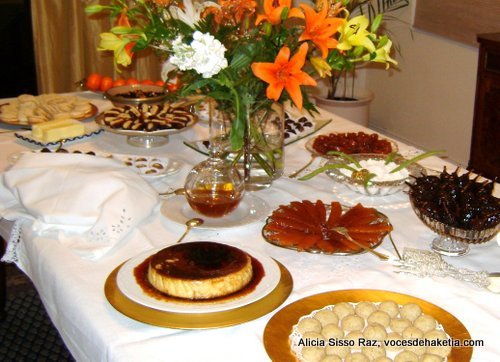
The earliest documentation of this festival appeared in the eighteenth century, recorded by Shmuel Romanili—an Italian Jewish traveler who visited Morocco. He wrote that on the final night of Passover, Jews prepare tables laden with all kinds of delicacies, sweets, and sugared fruit (letuarios), honey, milk, eggs, fish, flowers, lettuce, walnut and almond —and adorn their homes with flowers and wheat stalks. The doors of the homes remain open, and Jews visit one another to receive beraḥot (blessings) and bestow blessings upon the host in return. Letuarios are made from a variety of fruits and vegetables: oranges, baby eggplants, mandarins, cherry tomatoes, grapes, raisins. The most cherished letuario is the one made from orange blossoms. We prize the color, taste, and fragrance of the orange blossom so greatly that we always wish one another to have a mazzal – a stroke of good fortunes bright and pure as the blossom itself.
These elements of the Mimona night remain the same to this very day: the open doors, visiting family and friends, decorating the homes with flowers, greens and wheat stalk, reciting the specific blessing, and the visual hiba (elegance or beauty) of the spread on the table. Many researchers who traveled to Morocco have noted, almost without exception, the hiba (elegance) of these festive tables. In Wazzan, a small village, it was written that the festive table must have hiba.
Everybody is welcome to join the festivities on the Mimona. Doors are left open and homes are decorated with flowers, greens and wheat stalks. Tables are set up with symbolic food and a variety of sweets, prepared during the holiday, and therefore still kosher for Passover. The Mufleta, the traditional crepe-like, eaten with butter and honey, is hametz. Some replace the Mufleta with lettuce and honey. The following day is the customary picknick day, when families and friends continue their leisure activity, preferably by rivers or fountains.
And the blessing mentioned by the travelers is still recited to this day: Terbaḥu u tes’adu—a blessing for «prosperity and happiness.» In northern Morocco, the blessing of a similar meaning: a Mimón a Shalom a baba terbaḥ, is commonly used.
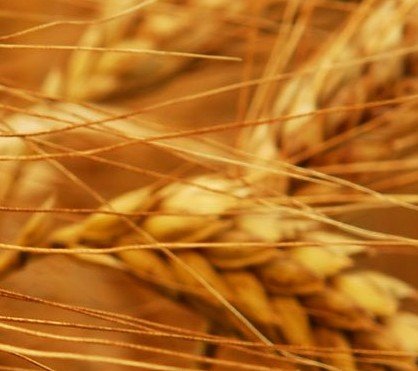
Some would recite this blessing while holding lettuce and honey; others would tap the recipient’s forehead with a wheat stalk dipped in flour or milk. My father used to tap the forehead with wheat stalks dipped in flour, while saying the blessing.
In Morocco there was a rigid order of the visits upon leaving the synagogue in evening of the Mimona. It was customary to first go to the homes of the Cohanim and of the rabbis for their blessing, bestowing the blessing in return. This was followed by visits to the homes of the elders and heads of the community, and then to visit family and friends.
The origin of the Mimona celebration is quite ambiguous. There are several theories regarding the origin of the Mimona, or as it is called by the Spanish-speaking Moroccan Jews- Noche de Mimona. It has been connected to the se’uda (yurtzeit) honoring the memory of Rebbi Yosef Maimon, the father of Maimonides, who passed on that night. Others cling to philological explanation, connecting Mimona to the word Emuna –the belief in the redemption, that soon is coming, while others to indicate the reason for good relations between the jews and the Moroccan autochthons, the Berbers.
However, it seems that none of the above is plausible. Mimona is simply a spring celebration. Pesah occures in the month of Nissan, which was the first month in the biblical calendar, rather than today’s month of Rosh Hashana. The biblical Rosh Hashana was than on Passover! Mimona seems to be a celebration of Spring and of the beginning of the year, an expression of hope for a successful harvest and abundance in the world. This explains the relations between the words Mimona and Mammon (wealth), which implies prosperity in Aramaic and in Hebrew. The agricultural aspect in the joyous Mimona supports viewing it as a Spring celebration: homes decorations with all kinds of greens, flowers and wheat stalk, and tables set up with abundance of symbolic foods and sweets. This view is favored by many.
In my recent research on the Mimona, I discovered interesting historical facts that buttress and reinforce the thought of the Mimona being a spring celebration, marking the beginning of the biblical new year, with all the hopes and wishes for a successful one.
I found out that earlier communities in Israel used to decorate the homes on the last night of Passover with wheat stalks and used to go to rivers the following day. In a testimony from the nineteenth century, it mentions that the people from Tiberias used to decorate their houses on the last day of Passover with greens and flowers. Just as is the Moroccan Jewry custom to date.
!Moreover, they used to tap the forehead with wheat stalks as a wish for a good harvest and a good year. Again, just as we do! Thus, the source of our custom originated back then, when we were farmers in Israel in ancient times.
The Jews of Rhodes, for example, mark the last night of Passover with happiness and laughter, and by throwing candies and coins on the heads of the children. The Jews of Portugal, centuries ago, used to go the rivers, the day following the last day of Pesah, just as is the Moroccan Jewry custom. Actually, the last night of Passover is being celebrated by many Jewish communities, with some, with some similar elements. Moroccan Jews call this celebration Mimona, however, no other community surpasses the abondance and beautiful characteristics of the Moroccan Jewry celebration.
The Mufleta
Mufleta is the Judeo-Moroccan name of the flattened crepe with which Moroccan Jews start to eat hametz. Msemna or Trit is how the Moroccan Muslims call a similar version of the Mufleta.
A while ago I came upon a Sandwich originated in Sicily made of flattened soft bread, rolled into a cylinder-like shape, that is called Mufuletta or Muffaletta. I found the resemblance in shape and linguistic to be striking. I was wondering about its etymological origin. In the encyclopedia of Jewish food, it is said that the Jews who fled from Spain to Morocco after the expulsion brought with them the Mufleta. It is added that the word is related to “pan Mouflet” —a medieval Provincial word for a round and soft bread baked on a griddle. The Mufleta used to be prepared on a flat griddle, or an upside-down shallow pan. In Miriam Webster dictionary a relation is mentioned to Muffula— a fur mitten. In Spanish however, mofletes mean puffy cheeks. All these variations are associated then with bread or items of soft or puffy rounded shape. From this we can infer that the Moroccan Jewish Mufleta, the Sicilian Muffuletta, the Spanish mofletes and the provincial Pan Mouflet may have the same etymological origin, which may go back to Late Latin. The shape and texture are similar—soft, flat and round. The Mufleta is rolled out into a cylinder and filled with butter and honey. The filling ingredients of the Sicilian Muffuletta are cheese and sausage.
If Late Latin is the origin of the word, can we assume that the name Mufleta may have indeed crossed the strait of Gibraltar to Morocco with the expelled Jews?
One puzzling thing remains. Why do the Jews in Northern Morocco who preserved their Spanish call it Terit, like the Muslims, whereas the Jews from Central and Southern Morocco call it Mufleta, a term that signals to a romance linguistic origin?
≈≈≈≈≈≈≈ ≈≈≈≈≈≈≈ ≈≈≈≈≈≈≈ ≈≈≈≈≈≈≈ ≈≈≈≈≈≈≈ ≈≈≈≈≈≈≈
The traditional symbolic food on the Mimona table
♣♣♣♣ – Fish – for good luck.
♣♣♣♣ Flour, milk or buttermilk, and honey–alluding to Eretz Israel and to purity.
♣♣♣♣ Assortment of cookies made of almonds and nuts symbolizing joy and abundance.
♣♣♣♣ Eggs, bean pods, and various greens — symbolizing fertility and prosperity.
♣♣♣♣ Wheat stalks — referring to «kol Israel ‘arevim ze la ze” and to brotherhood sentiment in general.
♣♣♣♣ Dates — alluding to righteousness (Tzadik ka Tamar)
♣♣♣♣ Assortment of caramelized fruits and preserves for a sweet year.
♣♣♣♣ Fish for good luck.
♣♣♣♣ Mufleta or Terit (the traditional crepe), spread with butter and honey, and into a cylinder — a symbol for a sweet start of Ḥametz-eating, and for the thereafter.
All are welcome to join the celebration; doors are left open. Each guest, whether familiar or stranger, is encouraged to enjoy the sweets and deserts, and is greeted with the traditional blessing: Tirbehu Utis’adu (success and good luck in Judeo Moroccan), and the Spanish-speaking greet everyone with: A Mimon, A Shalom, A baba terbaḥ
© 2010, 2018 Alicia Sisso Raz