
Alicia Sisso Raz
Version en Ḥaketía
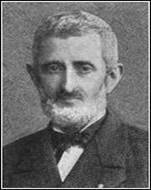
Eminent scholar and original thinker, rabbi of his community for fifty years, teacher of theology at the Rabbinical Academy of Livorno, kabbalist, and a humanist above all, it is no wonder that Rabbi Elijah (Eliyahu) Benamozegh was referred to as «Plato of the Italian Jewry». This remarkable intellectual leader of the Italian Jewry in the nineteenth century has been commemorated with the Piazza Benamozegh as tribute to his name and distinction.
Rabbi Benamozegh (1823-1900) was born in Livorno to his parents native of Fez, Morocco, who like many other Jews of the Mediterranean, left their birthplace, and chose to settle in this city. Livorno’s importance as a vital center to the Sephardic diaspora dates to the sixteenth century. The grand Duke of Medici granted religious freedom and equal rights to all the citizens. Soon enough, Livorno became a magnet, attracting Jews from all over the Mediterranean region, including anusím from Spain and Portugal. Many Moroccan Jews, lucky enough to escape the dreadful conditions in Morocco, flocked to the city. The Sephardic Jewish community became prosperous and successful, known for its scholars, as well as for its internationally recognized acumen for trade and business networking. The Talmudist, Jacobo Haggis, the Montefiore family and Amadeo Modigliani, were but a few notable members of this community; two piazzas in Livorno have been named after distinguished members of the Jewish community: Piazza Benamozegh and Piazza Attías.
Benamozegh’s father, Abraham, died in his infancy, leaving him with his mother, Clara, and his uncle, Rabbi Yehuda Coríat. A prolific writer from early age — at sixteen Benamozegh wrote a preface to rabbi Coriat’s Maor Vashemesh — he left an extensive and daring number of books and articles in Italian, Hebrew, and French. Israel and Humanity, his major work on religious universalism, is a synthesis of his philosophical thought, on Judaism and its relations to other religions. His introduction leaves no doubt to its depth and scope: «Israel and Humanity: Proof of the Cosmopolitanism in Judaism’s Principles, Laws, Worship, Vocation, History, and Ideals». Benamozegh’s universalism and humanistic view is evident in this book; he juxtaposed and analyzed the thoughts and arguments of key thinkers, such as Maimonides and Spinoza; Greek and modern philosophers; German theologians as well as the Gospels.
Aimé Pallière, Benamozegh’s disciple and posthumous editor of Israel and Humanity stated that Benamozegh’s philosophical thought and his view of the Kabbalah stems from both the European humanistic tradition and his Moroccan roots. Alessando Gueta, Benamozegh scholar, wrote that the centrality of the Kabbalah in Benamozegh’s thought was “imported from Morocco”. Kabbalah and Guemarah – as the Sephardim call the Talmud – have been equally valued throughout the Sephardic world. Yet the Kabbalah has been particularly central in the Judeo Moroccan tradition, and Benamozegh regarded it as «the perfect form of Judaism».
Sephardic Rabbis have ever since encouraged the daily reading of the book of Zohar, and Rabbi Haim Yosef David Azoulay – the HIDA (Jerusalem, 1724-1806) – thought it to be instrumental for the perfection of the soul. Similar thought had been expressed by his great grandfather, Rabbi Abraham Azoulay (Fez, 1570-1643) and by other Sephardic rabbis as well. Thus, Benamozegh’s approach to Kabbalah is not surprising; he regarded it as a philosophical system with spiritual qualities. At the same time, he regarded the Halakhah, as a universally all-encompassing ethical system. Thus, according to Benamozegh, the spiritual character of the Kabbalah coupled with the universal moral qualities of the Halakhah offer an ideal and practical guideline, applicable to the entire humanity, for conducting a worthy life.
Benamozegh was an advocate for interfaith dialogue, and especially for Jewish-Christian reconciliation. Judaism, he thought, should not be isolated or set against the world; after all, Gentiles are bound in part to the Mosaic commandments, known as the seven Noachide Laws. He maintained that this common ground is more significant and unifying than whatever stands between Jews and Gentiles. Yet, misconception about Judaism persists; it stems from ignorance on its true nature and qualities. This false notion would continue among Gentiles and even among the emancipated European Jews, if the moral and spiritual aspects of Judaism would remain unknown.
The European enlightenment had been embraced by all, but it posed a new challenge to European Jewry. The perception that enlightenment and Jewish faith and practice are two irreconcilable extremes had distanced many contemporary European Jews from their forefathers’ faith. The Haskalah movement in the late eighteenth century – the German Jewry version for the European enlightenment – looked with admiration at the legacy of Sefarad. Nonetheless, they came short of adapting the Sephardic dictum of «Be an observant Jew at your home and a man of the world outside», and many forsake their religious roots. Benamozegh’s philosophical thought reconciles Judaism with the principles of enlightenment. The wide range of his spiritual, intellectual, and ethical works coupled with his religious tolerance, is noteworthy.
Regrettably, the European intellectual Jewry have associated Benamozegh with merely the Kabbalah, which was viewed as a set of theological superstitions. On the other hand, his daring and original thought was rejected by orthodox rabbis. Em La-Mikra, his five-volume commentary on the Torah, from philosophical, philological, historical and kabbalistic point of view, was condemned for heterodoxy. The books were set on fire «by some excessively zealous rabbis from Aleppo», as Benamozegh commented on their rejection.
Benamozegh’s ideas have recently been capturing the attention, and his books and publications are being translated into several languages. His latest book, Israel and Humanity (originally- Israël et l’humanité) has been translated into English a few years ago. It is unfortunate, however, that this great thinker remains largely unknown to the wider public, especially in Israel. His liberal and humanistic teachings are extremely important, especially in Israel, where the religious views and interpretations are becoming more and more ultra-orthodox, and many Sephardim are forsaking the lenient Sephardic customs by following the austere Ashkenazic orthodox traditions.
The teachings of this extraordinary intellectual rabbi should be part of the curriculum in Israel and abroad. «He has not been included in the university course on nineteenth century Jewish intellectuals, because he is largely unknown», was the reply of a university professor in the faculty of Jewish Studies, when asked why Benamozegh is excluded from the course teachings. That response is infuriating. Such a reply is logically fallacious, Post hoc ergo proper hoc fallacy — after this, therefore because of this. Indeed, How Benamozegh can be known if he is not introduced and included in universities curriculum?
© 2010, Alicia Sisso Raz
www.vocesdehaketia.com
Glossary
Kabbalah – collective Jewish mystical thought.
Halakhah – collective body of the Jewish religious law and dictum.
Midrash – explications and interpretations of Jewish texts.
Guemarah or Talmud – commentaries and explications of the Torah by ancient rabbis that form the Jewish law.
Torah – the five books of Moses.
Zohar – The book of splendor. The primary book of Kabbalah.
Books by Rabbi Eliyahu Benamozegh
Emat Mafgia (The Fear of the Opponent) Defending Rabbi Leone Modena
Ger Ẓedeḳ (A Righteous Proselyte)
Ner le-David (Lamp of David), commentary on the Psalms
Em la-Miḳra (Matrix of Scripture), commentary on the Torah.
Ṭa’am la-Shad (arguing with Samuel David Luzzatto’s on the Kabbalah)
Morale Juive et Morale Chrétienne (Jewish and Christian Ethics)
Israël et l’humanité (Israel and Humanity), translated by Maxwell Luria.
Sources
Benamozegh, Elijah. Israël et l’humanité (Israel and Humanity), translated by Maxwell Luria.
Gueta, Alessandro. Philosophy and Kabbalah
Pallière, Aimé. «Preface to the first Edition», Israel and Humanity
Trivellato, Francesca. The Sephardic Diaspora, Livorno, and Cross-Cultural Trade in the
Early Modern Period
Schorsch, Ismar. «The Myth of Sephardic Supremacy» in Leo Beak Institute Yearbook xxxiv